
"Panama coffee history"
1000 article(s) found

A brief introduction to the origin, development, history and culture of boutique coffee beans in the elegant and charming Manor Erida in Panama.
In addition to creating good coffee cultivation conditions, the Lamastus family, which runs the Elida estate, has also planted many different native tree species on the estate, not only to shade the coffee trees, but also to provide a friendly habitat for birds. In terms of fertilization, the Lamastus family uses artificial fertilization and a small amount of chemical fertilizers, but never uses pesticides and herbicides that are harmful to the environment. Eye

A brief introduction to the Origin, Development, History and Culture of SHB Kaddura Fine Coffee beans in Ireta Manor, Panama
Coffee was introduced into Panama in 1780, when Europeans introduced the first Typica tree species. After that, this mysterious and strange drink conquered the senses of Panamanians, and the local people began to grow it widely. Panamanian coffee is very smooth, full particles, light weight, and perfect acidity balance, its high-quality coffee bean flavor is pure, very distinctive. Because of its wide popularity, Panama University

A brief introduction to the origin, development, history and culture of Cupid coffee beans with elegant flavor
Panama is located on the Panamanian isthmus in Central America, bounded by Colombia to the east, the Pacific Ocean to the south, Costa Rica to the west and the Caribbean Sea to the north. The territory is S-shaped to connect North and South America, and the Panama Canal connects the Atlantic and Pacific oceans from north to south. It is known as the bridge of the world. [5] Panama has a land area of 75517 square kilometers, a land length of 772km and a width of 60 to 1.

A brief introduction to the Origin, Development, History and Culture of Rose Summer Blue Standard washed Fine Coffee beans in Panamanian Jade Manor
The pronunciation of Geisha is the same as Japanese geisha, so it is also called geisha coffee. Because the tree species are taller than ordinary coffee trees, they are originally planted in a small area of the manor and are used as windbreaks. In order to take part in the annual competition for the best coffee in Panama, the son of the manor owner searched all the coffee trees in the manor for testing, which gave Geisha a chance to appear on the stage.

A brief introduction to the Origin, Development, History and Culture of Coffee beans in Alida Manor of Citrus
Always have a strong preference for African beans, the impression of Central American beans seems to me as a synonym for moderates, whether it is Costa Rica or Guatemala, Caribbean island coffee is synonymous with fruit juice. And this Panama did give me a pleasant surprise, refreshing fruit acid is obviously more vivid than other countries in China and the United States and closer to the ripe sweet and sour aroma of the fruit.

Taste the region │ Panama's four major producing areas and the road to boutique coffee
Professional barista communication please follow the coffee workshop (Wechat official account cafe_style) do you know? In Panama, there is a kind of coffee with special flower and fruit flavor. it not only attracts the focus of the world, but also creates an auction event of high-quality coffee at the auction of raw beans every year. Its name is Geisha. The History of Coffee in Panama in 1780, Europeans were the first to put the first Typica tree species

Panamanian Coffee Sun Geisha Champion Manor introduces the legendary history of aurora manor in Walken.
For the exchange of professional baristas, please follow the coffee workshop (official Wechat account cafe_style) country: Panama: Walken altitude: 1485-1700 m treatment: washing grade: SHB variety: Kadua seed flavor description: flower, peach, orange peel, fresh fruit aroma, almond, stone fruit, roasted nut. 2013 Best of Panama Champion (Sunshine

A brief introduction to the Origin, Development, History and Culture of Fine Coffee beans in Hartman Manor, Panama
Today's Hartman Manor is a family business founded by Latip Hartman (son of Eloise) in 1940. In 1966 Latip married Dinola Sandy of Costa Rica. They have five sons, Latipa Jr., Alan, Alexander, Alice and Kelly. Each family member is responsible for the growth management, harvest treatment and manor visit of the coffee.

A brief introduction to the history and culture of the origin and development of Panamanian boutique coffee jadeite manor
Red bid Rose Xia participates in the global bidding auction in May every year. Green bid does not participate in the auction, but it is also of high quality and the price is slightly cheaper. Buyers who buy red bid can give priority to buying green bid. [flavor description]: oolong tea, peach, honey, fresh and comfortable, bright and balanced, strong hierarchical sense of aroma, the whole aroma and caramel sweetness wrapped together, entrance tongue

A brief introduction to the History and Culture of the Origin and Development of Panamanian Flint Manor Coffee
Catuai: Catuai Kaduai is a hybrid of New World and Kaddura. It inherits the advantage of low height of Kaddura tree and helps inherit the advantage of low height of Kaddura tree. The variety name Catuai comes from vernacular, meaning very good (very good). As a member of Arabica family, Catuai is relatively high-yielding. Cup test flavor: dry fruit, rich

A brief introduction to the History and Culture of the Origin and Development of Fine Coffee beans in Hartman Manor, Panama
After the beginning of World War I, he was abandoned as a little boy. Thanks to his mother, he was able to hide in a ship bound for Pennsylvania and survived. Both of his brothers died in the war after joining the army. Luis Hartmann traveled to some countries with his friends until he came to Panama in 1911 and was in Chiriki in 1912.

The history, culture, stories and allusions of the holy boutique beans of the Manor Erida in Panama
For the exchange of professional baristas, please pay attention to the coffee workshop (Wechat official account cafe_style) the history, culture, stories and allusions of the holy boutique beans of the Erida Manor in Panama. Poquet has always been the most eye-catching coffee producing area in Panama, and there are many famous manors in the area, such as the Emerald Manor (Esmeralda), which is famous for Geisha varieties, World War I, and Best of Panama.

A brief introduction to the History and Culture of the Origin and Development of Fine Coffee beans in Alida Manor
La Esmeralda Manor was bought by Price Peterson's father, Rudolph A. Peterson, a Swedish banker. He was the president of Bank of America and was a big shot in the financial circle at that time. Rudolph bought Hacienda La Esmeralda only for vacation and later retirement. It should not have been expected that the estate would become world-famous and even become a Panamanian boutique coffee.

A brief introduction to the History and Culture of the Origin and Development of Fine Coffee beans in Hartman Manor, Panama
Today's Hartman Manor is a family business founded by Latip Hartman (son of Eloise) in 1940. In 1966 Latip married Dinola Sandy of Costa Rica. They have five sons, Latipa Jr., Alan, Alexander, Alice and Kelly. Each family member is responsible for the growth management, harvest treatment and manor visit of the coffee.

A brief introduction to the Origin, Development, History and Culture of Fine Coffee beans in Jadeite Manor
The BOQUETE region of Panama, located in the province of CHIRIQUI on the border with Costa Rica, is home to Panama's famous GEISHA coffee and is famous for producing high-quality Arabica coffee. Tedman & TEDMAN&MACINTYRE ESTATE Manor in the mountains 4000 feet above sea level in Poggett, originated in Panama

A brief introduction to the origin, development, history and culture of Panamanian Kasha boutique coffee beans with unique orange flavor and honey flavor
This is good. Coffee bugs benefit from Panama's geographical conditions from east to west, allowing cold air to flow through the Central Mountains and converge at more than 6500 feet, thus forming a variety of unique microclimates in places such as Boquete, Volcn, Candela and Santa Clara, coupled with nutrient-rich and balanced volcanic ash soil.
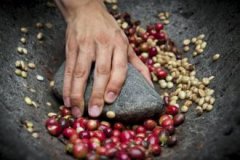
A brief introduction to the Origin, Development, History and Culture of Fine Coffee beans in Arida Manor with rich aroma
This bean is fully washed and processed, the appearance is fresh emerald green, the bean is full and shiny, it looks like a high-density hard bean. Baked to an obvious degree of high fruit aroma shows, the entrance is also juice-like sweet and sour, bright and refreshing. Baking a little deeper, the sweetness of vanilla and nectar in the dried fragrance are mixed together, and the baking degree and acidity of high+ are decreased.

Brief History of Panamanian Rosa Coffee
In 931, it was exported to Kenya in obscurity from Geisha Mountain Mountain in southwestern Ethiopia (coincidentally synonymous with Japanese geisha), wandered to Tanzania and Costa Rica, was transplanted to Panama in the 1960s, and then went through nearly half a century before it became a blockbuster, defeating the victorious armies such as Bourbon, Kaddura, Kaduai, Tibica and so on, winning 2005 and 2 in one breath.

A brief introduction to the history and culture of the origin and development of geisha coffee beans with jasmine fragrance
Geisha Mountain (coincidentally synonymous with Japanese geisha) in southwestern Ethiopia was exported to Kenya, wandered to Tanzania and Costa Rica, was transplanted to Panama in the 1960s, and then survived nearly half a century before it became a blockbuster, defeating the victorious armies of Bourbon, Kaddura, Kaduai and Tibica, winning Panama in 2005, 2006 and 2007 in one breath.

A brief introduction to the origin, development, history and culture of Cupid boutique coffee beans with bright taste
According to the information obtained from the raw bean merchant, due to the historical reasons of the manor, in order to pursue yield at that time, the early rose summer varieties were mixed with the coffee trees of Kaddura and Kaduai, and in order to facilitate picking, coffee farmers did not reclassify them, but directly mixed the three varieties. After that, as Rosa rose to fame, the price soared, and the processing plant